
SPIRE leads discussion on industry in Europe
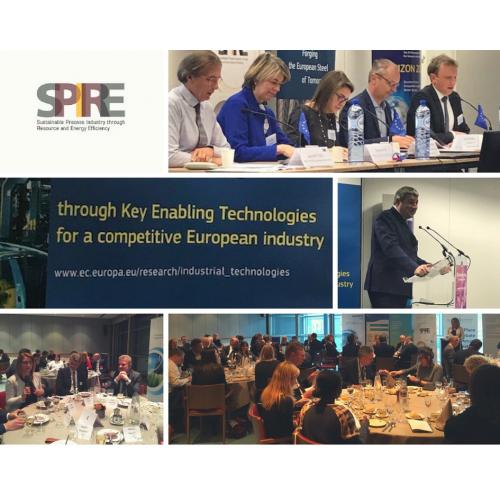
SPIRE collaborated with the European Commission in the the ‘Sustainable Industry’ session on 23 February 2018 at the EU Industry Days, which addressed the development and deployment of competitive and sustainable industrial technologies in Europe. This was followed by a dinner debate in the European Parliament on 25 April co-organised by SPIRE, Cefic, ESTEP, EURAMET and K4I. This event sought to identify the role of industry in the next Framework Programme (FP9). Below you will find the conclusions from both events.
With 1.8 EUR trillion turnover in 2015, the process industry represents more than 56% of industrial value added in the EU and around 10% of all economic activity. It provides 6.3 million direct jobs in the EU and a further 19 million indirect jobs. The Directorate-General of Research and Innovation at the European Commission (DG RTD) highlights that one in five jobs come from European industry, annual productivity growth in industry is at 2.7% and that two thirds of investment in innovation stem from EU industry.
Daniel Gauthier, President of A.SPIRE and member of the board at Heidelberg Cement, who had interventions at both events, says the process industries are the enablers of the carbon neutral economy and society. Improvements in energy and resource efficiency in the process industry have a direct effect on the whole value chain and it is therefore essential to support process industry to achieve a fully circular and carbon neutral economy in Europe. Already, the European process industry outperforms the EU industrial average in terms of reducing energy use and greenhouse gas emissions (GHG). He emphasizes that “The process industry is the backbone of the EU economy.”
SPIRE is now in the process of revising its original SPIRE2030 roadmap to create a Vision2050, which will define how the public-private partnership (PPP) can contribute to reduce CO2 footprint, improve water and waste use, preserve natural resources and provide health and welfare to EU citizens. The eight SPIRE sectors are working together to create a joint strategic approach and provide solutions for common challenges. More sectors are welcome to join: the goal is to have all the process industries represented in the SPIRE association.
The new Vision2050 will benefit the process industries’ competitiveness and position them as leaders in the transition to a carbon-neutral and circular economy including specific technological developments on carbon, and water and waste management.
In addition, two main transversal topics to achieve a fully sustainable, agile, flexible and competitive process industry have been identified: industrial symbiosis (a major cross-sectorial strength area for SPIRE) and digitalisation (fundamental for process optimisation).
Currently, the EU is not investing as much into research and innovation (R&I) compared to its counterparts: the US, Japan, Korea and China. Therefore, stronger collaboration needs to be fostered within Europe, as well as of industry with the Member States (MS) and with the regions.
Another conclusion reachedduring the discussions is that the process industry, through SPIRE, needs to continue to build and design an ecosystem which offers the market potential for the fostering of breakthough technologies or key enabling technologies (KETs). It is important to create together an environment where these big ambitions can be achieved and developed for the process industry and EU society at large.
Obstacles need to be turned into opportunities, which address the scarcity of resources and where regulation can play an important role in achieving it. The impact on biodiversity needs to be reduced and solutions found for the increased pressure in reaching CO2 targets. To create these new opportunities, flexibility in financial and funding instruments which help “de-risk” innovation and develop the industrial technologies to TRL9, are essential.
Furthermore, the SPIRE association is a partner of the FUTURING project, which explores future scenarios concerning EU industry through the use of foresight and other policy intelligence tools, to identify critical factors on which action should be taken in order to overcome barriers and to foster opportunities for the EU re-industrialization process.
In alignment with the recommendations from the H2020 project “FUTURING”, SPIRE considers it important for the EU to facilitate the integration and maturity of technological solutions applied across different disciplines and sectors to develop novel circular economy implementations. Furthermore, the EU has to develop incentives for industrial symbiosis, to enable and invest in circular economy innovations, to foster innovation that delivers environmental and societal impact, and to strengthen eco-innovation logic and circular economy principles in education.
The conclusions drawn from these two events are instrumental in the next steps to take for stakeholders of industry in Europe. SPIRE believes that the factors identified during these discussions will serve to position and clearly define which approach to adopt within FP9. Mr. Gauthier called for a strong budget for FP9 to be included in the EU’s Multi financial framework for 2021-2027. He emphasised there is much potential, with the right strategy and fundig, for the industry to contribute to global and European goals.